
Power Quality Engineering for YMTC 3D NAND Chip Manufacturing Base
Active Harmonic Filtering (AHF) solution applied in a high-value semiconductor fab environment
- Industry: Semiconductor manufacturing (3D NAND / SSD supply chain)
- Project significance: High-value, precision production environment with strict uptime and stability requirements
- What we delivered: Low-voltage Active Harmonic Filter (AHF) cabinets + on-site engineering support
- Business aim: Improve electrical stability to protect reliability, OEE, yield, and operating cost
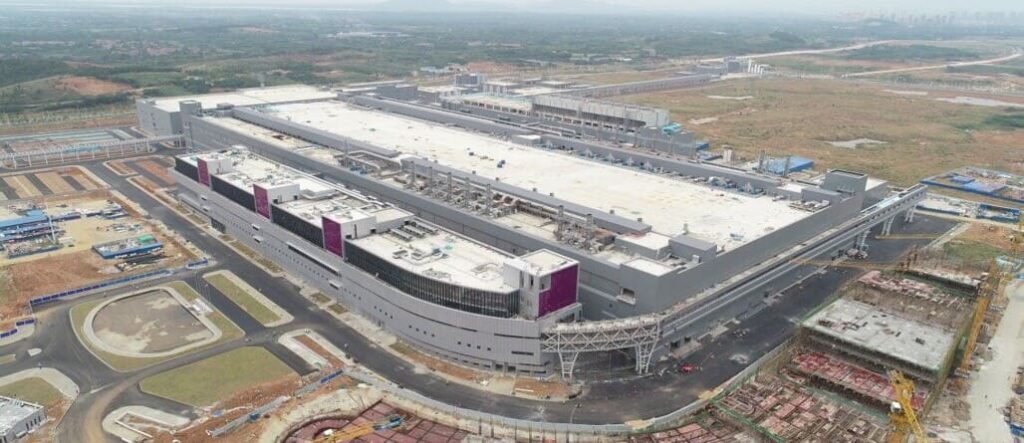
Project Context:
Yangtze Memory Technologies Co., Ltd. (YMTC) is a global semiconductor company specializing in flash memory and storage solutions, operating across design, process development, wafer fabrication, packaging/testing, and sales. Its Wuhan manufacturing base—built with multi-billion-dollar investment for high-volume 12-inch wafer production—stands among the largest memory-chip production facilities worldwide.
In this environment, the electrical system directly protects high-value equipment. Many machines cost millions of dollars and operate under demanding conditions; even slight power instability can cause abnormal behavior, forced shutdowns, or damage—with heavy losses. That is why power quality work here is not an efficiency upgrade, but risk control for stable output and predictable manufacturing cost.
Why power quality is unusually challenging in a flash memory fab
In many factories, “harmonics” come from a handful of big drives. In a memory fab, it’s different: the sources are everywhere, and they run all the time.
-
Process tools that behave like concentrated non-linear loads.
Across etch, deposition, implant, clean, and thermal steps, you’ve got tools packed with rectifier modules and high-frequency power electronics. They don’t draw power smoothly; they tend to pull it in pulses. When many tools run in the same area, that effect stacks up quickly on shared feeders and transformers. -
Facility systems that never stop running.
Cleanroom air handling, chilled water, pumps, exhaust, and vacuum support are full of variable-speed drives. One drive doesn’t look dramatic, but hundreds running for long hours can quietly become a major source of distortion across the plant. -
UPS and DC systems that keep the fab “always on.”
Fabs rely on layered backup power. Those systems protect uptime, but they can also add their own distortion upstream if not managed carefully.
When you put those three together, “power quality” stops being an electrical metric. It becomes a real operational risk: nuisance alarms, unexpected tool events, higher stress on distribution equipment, and an invisible drag on OEE and yield. That’s the core fab reality: a dense cluster of “conversion-heavy” loads, layered across tools and utilities, all interacting on the same distribution network.
What we delivered (solution built for fab realities)

We didn’t treat this as “install a cabinet and leave.” Our team approached it like a reliability improvement program. Our active filter cabinets were deployed to reduce distortion where it was accumulating and to keep the electrical environment steadier for both process tools and facility systems. The way we approached it was practical:
-
Central harmonic mitigation where it actually adds leverage.
Instead of fighting dozens of sources one by one, we applied active filtering at the points in the distribution system where many loads combine—so it can absorb distortion current before it spreads through the plant. -
Made it work with both worlds: tools + utilities.
The solution was configured to handle the “spiky” behavior of tool power supplies and the continuous contribution from variable-speed fans, pumps, and vacuum support equipment. -
Protected sensitive operations from “shared network effects.”
In a fab, one area’s distortion can affect other areas if it rides the same distribution path. We focused on keeping the overall electrical environment steadier so critical equipment is less exposed to upstream noise. -
Delivered it as a system outcome, not a product handoff.
Commissioning, settings, and on-site verification mattered as much as the hardware. We treated stability and repeatability as the deliverable.
(If there’s one thing I’ve learned in fabs: the best power-quality work is the kind operators stop talking about—because the problems stop showing up.)
Results and Benefits
After implementation, the fab gained a more stable power environment that better supports continuous production. In plain terms, the value shows up as fewer power-quality-driven disturbances, lower stress on the distribution system, and less recurring troubleshooting that steals time from the maintenance team. And because stability supports process consistency, improving power quality contributes to what leadership cares about most in fabs: higher OEE, lower scrap risk, better yield confidence, and more predictable cost control.
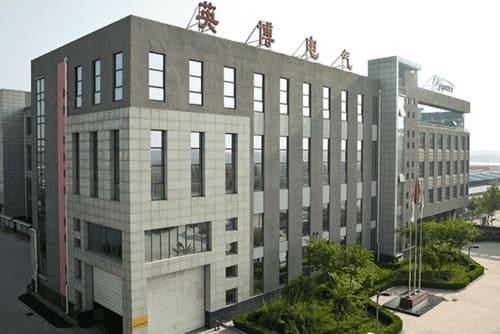
Yout Trusted Power Quality Solutions Provider from China
Enhancing Your Efficiency with Industry-Leading Power Quality Solutions
When power quality is critical, customers look for more than a product—they look for a partner who’s done it many times before. Yingbo Electric is one of China’s top three power quality solution providers, with 320+ IP rights (including 90+ invention patents and 50+ software copyrights) and participation in 50+ power quality standards. Our solutions have been deployed across industrial, commercial, infrastructure, and mission-critical environments, working alongside global brands, we help complex facilities achieve stable, compliant, and efficient power systems.

Intel Dalian's Non-Volatile Memory (NVM) ProjectPhase I Expansion

BOE Mianyang G6 AMOLED (Flexible) Production Line Project

Truly (Renshou)'s G5 TFT-LCD High-End Display Production Line Project

Xiamen Hithium Energy Storage Technology Co., Ltd

Huarui Optoelectronics LCD Panel Production Line Project

Canadian Solar (Yangzhou) Manufacturing Base
Shuangliang Silicon Materials (Baotou) Co., Ltd
Tongwei Solar Energy (Anhui) Co., Ltd
JA Solar Baotou Manufacturing Base Project

Tongren Hanergy Mobile Energy Manufacturing Base

Xinte Energy Xinjiang Polysilicon Manufacturing Base

YMTC 3D NAND Chip Manufacturing Base

CETC Monocrystalline silicon manufacturing base

China Resources Snow Beer Nanjing Manufacturing Plant Project

WUDELI Flour Mill Group Co., Ltd
Inner Mongolia Yijiahao Cheese Co., Ltd

CNPC Jichai POWER Company Limited

CNPC Soralchin Adrar Refinery
Let's talk about your project
Contact us to discuss your loads, harmonic profile, and reliability requirements. We’ll recommend a practical active filtering approach that fits your electrical system.